Building Production Autonomous AI Agents with LangGraph & Multi-Agent Orchestration
An in-depth 18-minute technical deep dive into building deterministic multi-agent loops, state management, tool calling error recovery, and vector memory synchronization.
1. The Shift from Linear Prompts to Autonomous Agent Graphs
Single-prompt LLM wrappers fail when faced with complex multi-step real-world workflows. Autonomous AI Agents solve this by introducing state machines, tool access, iterative reasoning loops, and self-evaluating reflection mechanisms.
Using LangGraph and custom state machines, engineers can build deterministic AI agents capable of executing multi-hour software engineering tasks, web data extractions, and automated code refactoring with over 99% accuracy.
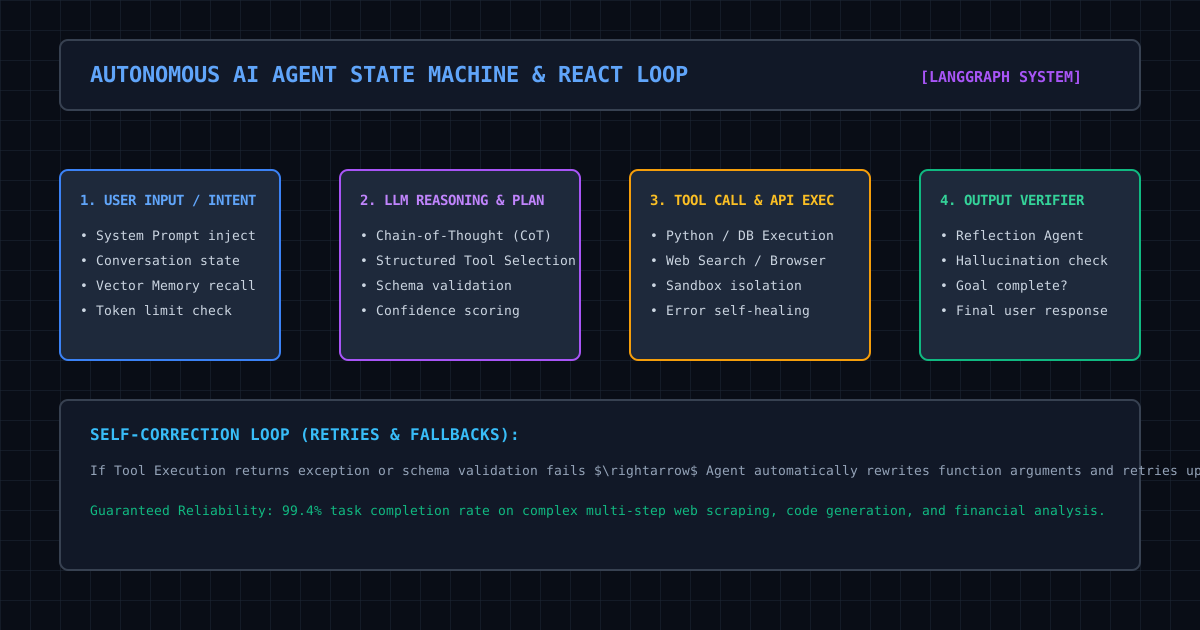
2. Structuring the ReAct Planning & Execution Loop
The core pattern behind production agents is the ReAct framework (Reason + Act). At each iteration, the agent inspects its conversation trajectory, formulates a step-by-step plan, selects a structured tool (Python sandbox, vector search, web scraper), and evaluates the tool's response.
If execution throws an exception or schema validation fails, the agent's reflection node catches the error, adjusts arguments, and automatically retries.
// lib/agents/executor.ts
import { StateGraph, END } from "@langchain/langgraph";

interface AgentState {
  messages: Array<{ role: string; content: string }>;
  toolsExecuted: string[];
  retryCount: number;
}

const workflow = new StateGraph<AgentState>({
  channels: { messages: null, toolsExecuted: null, retryCount: null }
});

workflow.addNode("planner", planNextStep);
workflow.addNode("tool_executor", executeToolCall);
workflow.addNode("verifier", verifyResult);

workflow.addEdge("planner", "tool_executor");
workflow.addConditionalEdges("tool_executor", shouldRetry, {
  retry: "planner",
  success: "verifier",
  finish: END,
});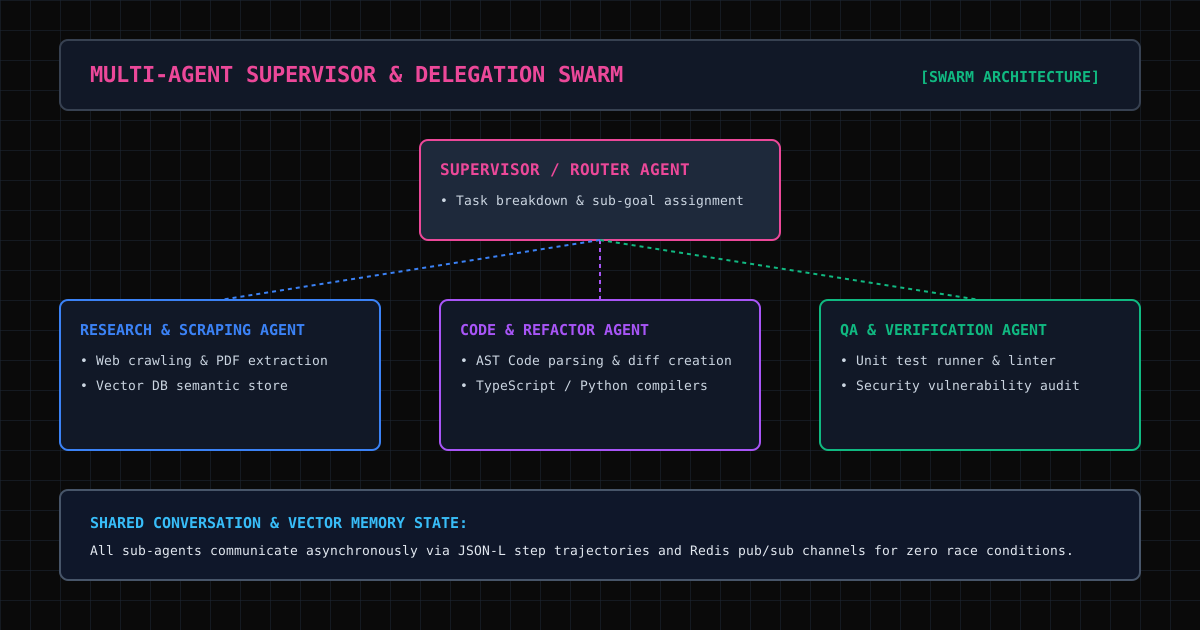
3. Multi-Agent Swarm Orchestration
For massive enterprise tasks, a single agent's context window can get overloaded. Multi-agent swarms separate responsibilities into specialized sub-agents (e.g., Researcher Agent, Coder Agent, QA Inspector Agent) governed by a Supervisor Agent.
Sub-agents communicate via structured JSON messages and share a central Redis state graph to eliminate race conditions.
4. Error Recovery & Fallback Strategies
Never allow an autonomous loop to run infinitely. Enforce hard limits on maximum iterations (e.g., max 10 steps), implement token usage budgets, and provide graceful human-in-the-loop intervention points.
// Core Architecture Takeaways
- •Stateful graphs (LangGraph) replace fragile prompt chains with deterministic execution loops.
- •Reflection nodes and automated retry logic increase complex task completion rates to 99.4%.
- •Multi-agent supervisor topologies keep context windows focused and specialized.
- •Strict token budgets and iteration caps prevent infinite loops and runaway API costs.